

Learn Sanskrit.
Discover a Deeper Understanding of Yoga, Philosophy and Traditional Texts.
Explore the Sanskrit language with me Elena. I am an experienced teacher with over 30 years of teaching experience. Whether you're curious about the words you use in yoga, want to understand the mantras you chant, or are ready to study Sanskrit in greater depth, I'll help you approach this fascinating language with confidence and curiosity.

There Are Many Ways to Explore Sanskrit
Perhaps you want to understand the Sanskrit words you use in your yoga classes. Perhaps you're drawn to chanting, curious about Indian philosophy, or ready to learn the language itself. Or maybe you're looking for specialist Sanskrit teaching for your yoga school or organisation.
Wherever your interest lies, there's a way to begin.

Short Courses & Workshops
Explore a little, learn a lot.
Discover Sanskrit pronunciation, yoga terminology, mantras, chanting and more through focused online courses and workshops.
Explore a particular interest, build your confidence and learn at a pace that suits you.

Longer Sanskrit Courses
Go beyond the basics.
Ready to spend more time with the language? My longer courses give you the opportunity to develop a foundation in Sanskrit, explore grammar and vocabulary, and begin to understand the language in greater depth. Whether you're a complete beginner or returning to previous study, you can take your learning further.

Sanskrit for Yoga Teacher Training
Give your students a deeper understanding of yoga.
Bring specialist Sanskrit teaching into your yoga teacher-training programme. From understanding āsana names and pronunciation to exploring mantras, philosophy and traditional texts, I'll help your students connect more deeply with the language and traditions behind their practice.

Bespoke Sanskrit Workshops
Bring the language to your community.
Looking for something different for your yoga studio, retreat or organisation? I offer engaging, accessible Sanskrit workshops tailored to your group's interests, from pronunciation and yoga terminology to chanting, mantras and philosophy. Sessions can be delivered online or in person.
Browse what's coming up


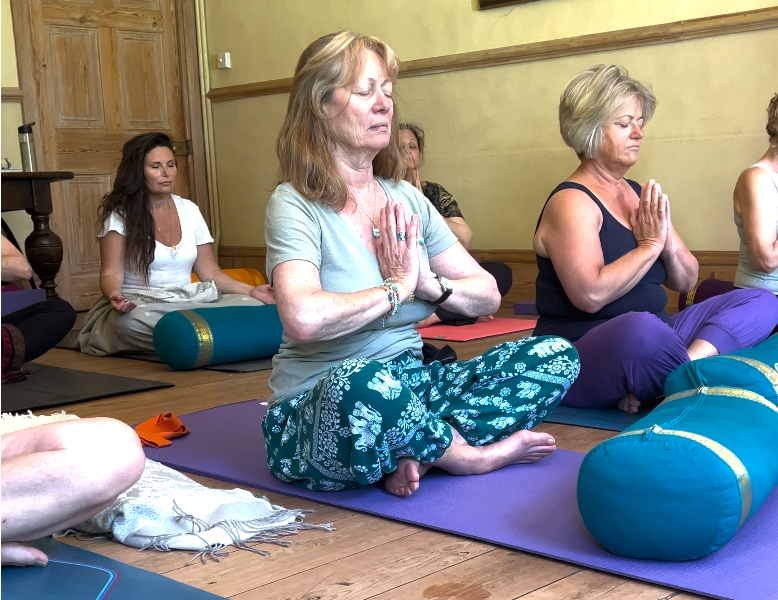

I offer a range of events and courses for groups and individuals including tuition, chanting, workshops and retreats, Yoga teacher training and Sanskrit for children.


Elena teaches with passion and care for her students, making learning enjoyable and interesting.
Diti, university student, Holland
I can't quite believe I've developed the skills to read and write Devanagari in just 4 days, but Elena has managed it!
Julie, Yoga teacher, UK
Despite the academic nature of the subject, I feel inspired and refreshed at the end of every session. I can't recommend her highly enough!
Alexandra, Sound Healer, UK
Sanskrit's Origins
Language of the Gods
Sanskrit, a classical language of the Indian subcontinent, is revered as the "language of the gods" and holds a significant place in ancient Indian culture. Known for its precision, rich literary tradition, and spiritual depth, Sanskrit has influenced many modern languages and remains a cornerstone of Hinduism, Buddhism, and Jainism.
Though the exact origins of Sanskrit are unknown, it is believed to have evolved over 3,000 years ago as part of the Indo-European language family. It is thought that Sanskrit initially developed as a means of preserving sacred hymns, rituals, and philosophical discourses. It was primarily used in religious ceremonies and rituals, with priests chanting mantras to invoke divine blessings and maintain cosmic order.
Modern Sanskrit
Over centuries, Sanskrit evolved into a sophisticated language with a highly developed grammar system, as codified by the ancient grammarian Pāṇini.
It became the language of classical Indian literature, encompassing epic poems like the Mahābhārata and Rāmāyaṇa, philosophical texts, scientific treatises, and extensive poetic works.
Its role expanded beyond rituals to include scholarly discourse, education, and administration.

Today, Sanskrit is studied and revered for its spiritual, cultural, and intellectual heritage.
Sanskrit used in:

Yoga
For understanding and correctly pronouncing āsanas (poses), mantras, and key philosophical texts.
Religious Practices
In prayers, hymns, and rituals to connect with cultural and spiritual traditions.
Academic and Linguistic Studies
As a subject of scholarly research and linguistic interest, providing insights into ancient civilizations and languages.
Āyurveda
To access and interpret classical texts for precise medical practices.
